

Server, application and protocol: three separate choices
Changing applications changes your interface. Changing servers changes where your account is hosted. A protocol enables exchanges between compatible services; it does not guarantee identical features.
| Situation | What matters | Practical decision |
|---|---|---|
| Application | The interface on your device | Check accessibility features and permissions. |
| Server | Account hosting and local rules | Read moderation rules, contact details and continuity arrangements. |
| Protocol | The technical rules for exchanges | Check actual compatibility between the services you need. |
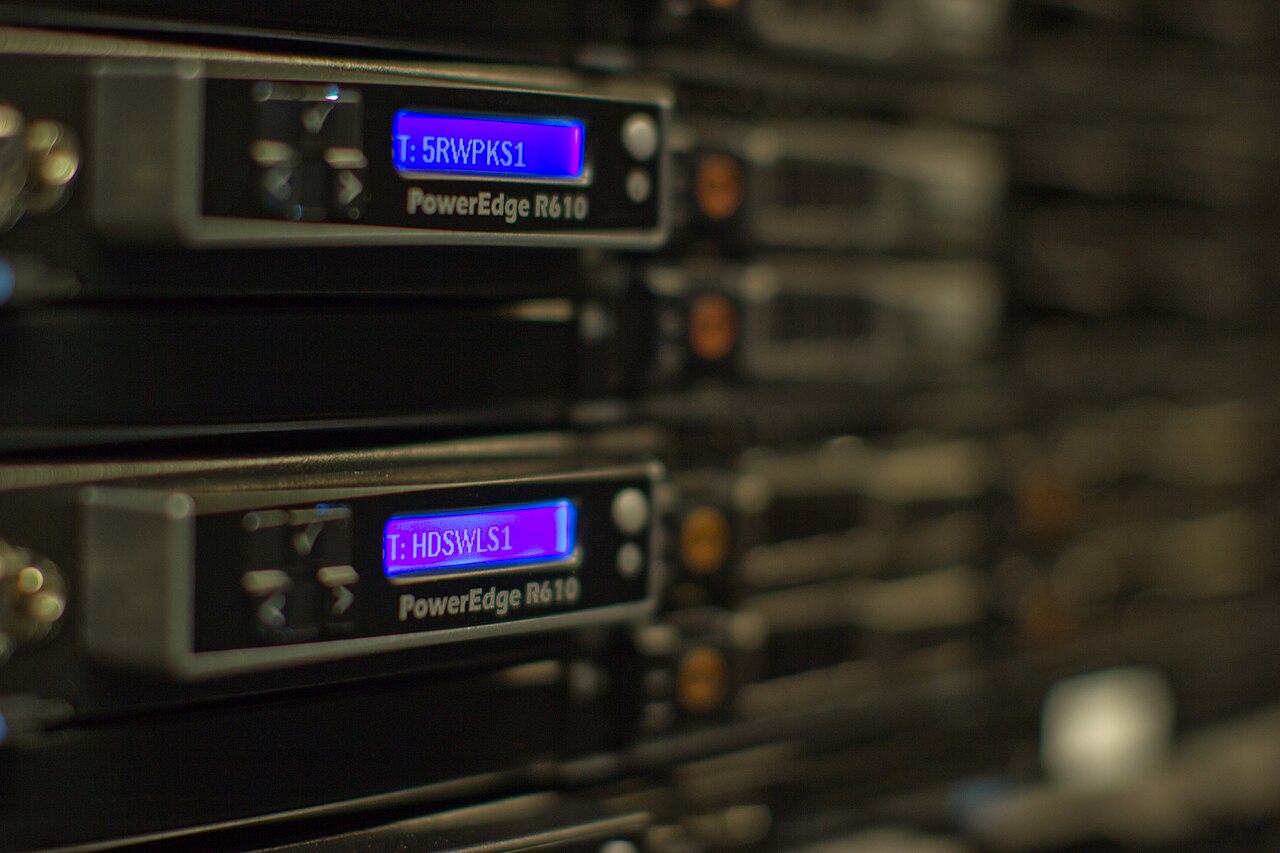
Real infrastructure: Wikimedia Foundation servers photographed on 16 July 2012. This historical image shows physical equipment; it does not depict a Mastodon server.
Real photograph, resized version · Victor Grigas · Source · CC BY-SA 3.0

1. Understand federation
Picture several separately hosted communities whose members can follow and reply to one another. ActivityPub describes how servers exchange social activity. Mastodon, Pixelfed and PeerTube illustrate different uses; their features and level of interoperability are not identical.
2. Choose a server carefully
Read its introduction, rules, moderation policy and contact details. Check whether its community, language and sign-up conditions suit you. Each server has its own administrators, so its availability and decisions matter alongside the software you use.
3. Check who can see your posts
A post intended to travel between servers can be copied or shared beyond its original home. Privacy and deletion features differ among software and servers. Do not assume federation is an encrypted private messaging service for sensitive conversations.
4. Try it before committing
Create an account, follow a few people on different servers and observe the conversations. Review export and account-move options before building a large presence. Keep your own copy of content you want to retain.
A concrete example
Situation. A photographer wants to publish on Pixelfed. She is choosing not only an app but also the server that will host her account and set moderation rules.
How to try it. She reads the rules, checks the server’s stated storage and export options, then posts a test image without sensitive information. She observes how it reaches other servers.
What to check next. Before moving a whole collection, she keeps the originals and records the accounts or communities she wants to find again. Federation does not make every post private.
Put this guide into practice
Compare rules and retention policies on two servers. Record your full handle and export options: changing servers does not necessarily move your full history.
How to assess the result
You know who hosts and moderates the account and what leaving can transfer.
Editorial exercise; adapt it to your situation and keep sensitive details out of your notes.
Sources and method
This editorial synthesis draws on the sources below. Features may change by service and country.
 W3C: ActivityPub Recommendation ↗
 Mastodon: Official documentation ↗
 PeerTube: Official introduction ↗
WORLD SOCIAL NETWORKS · Suggest a correction.
Keep exploring
Explore Mastodon · Explore Pixelfed · Explore PeerTube
Related methods
A question before putting this into practice
How can I check whether two open services actually interact?
Identify their protocols and expected functions, then test a precise interaction with the relevant accounts. Distinguish following, commenting, sharing video and moving an account. Open software or the word federated alone does not guarantee all these operations between services.